
Blog article
Dolby ATMOS Explained: What the Numbers Actually Mean

You’ve seen the configurations. 5.1.4. 7.2.4. 9.4.6. Every home cinema spec sheet throws these numbers around, but most people have no idea what they mean – or why they matter.
Here’s the full breakdown.
Where It All Started: 5.1 Surround Sound
To understand Dolby ATMOS, you need to understand what came before it.
The original Dolby Digital format was 5.1. Five speakers, one subwoofer. Three speakers at the front of the room – left, centre, and right – plus a surround left and surround right mounted on the side walls. Those side speakers sat quite high on the wall, close to a metre above head height, because they were doing double duty: creating both lateral and overhead spaciousness in a system that had no dedicated overhead channels.
It worked. For its time, it worked well.
Then came 7.1, which added two rear speakers to the back wall. The side surrounds moved forward to sit closer to the seating position. The rear surrounds anchored to the back wall. Sound could now pan from front to side to rear in a continuous arc around the listener. More enveloping. Better spatial separation.
But it was still a flat plane of sound. Everything happened around you. Nothing happened above you.
Why ATMOS Changed Everything
Dolby ATMOS was developed to solve exactly that problem. The name is deliberate – think atmosphere. A dome of sound that surrounds your listening position in three dimensions, not just left-to-right and front-to-back, but overhead as well.
When a fighter jet tears across the screen in Top Gun, it doesn’t just pan down the side wall of your room. It flies over your head. A helicopter doesn’t announce itself from the side – you hear it approach from behind, track overhead, and exit in front of you. That’s what ATMOS delivers.
To make it happen, Dolby added a third number to the speaker configuration. What used to be 7.1 became 7.1.4. That third digit is the overhead channel count.
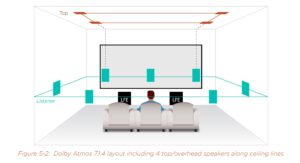
Reading the Numbers
Every Dolby ATMOS configuration follows the same format: X.Y.Z
- X – the bed layer. Your traditional surround speakers: front left, centre, front right, side surrounds, rear surrounds. This is 5, 7, 9, or 11 speakers.
- Y – the subwoofers. The bass channel. Read more about what subwoofers actually do here.
- Z – the ATMOS overhead channels. Ceiling-mounted speakers that place sound above your listening position.
So when you see 7.4.4, you’re looking at 7 bed layer speakers, 4 subwoofers, and 4 overhead ATMOS speakers. When you see 9.1.6, that’s 9 bed layer speakers, 1 subwoofer, and 6 overhead channels.
Simple once you know the key.
The Bed Layer: 5, 7, 9, or 11 Speakers
The bed layer is the foundation of your ATMOS system. Most rooms start at 7 channels: three at the front, two side surrounds, two rear surrounds. That’s a 7.x.x system.
Step up to 9 channels and a new speaker type enters the picture: the front wide. These sit on the side walls between the front speakers and the first set of surrounds. Their job is to bridge the gap in the pan – to make sound travel smoothly from the front of the room to the side without jumping between speakers. A noticeably more seamless effect.
At 11 channels, you add a second set of side surrounds. Three front speakers, two front wides, two first surrounds, two second surrounds, two rear surrounds. The sound field becomes genuinely continuous around the room.
For most high-performance cinemas, 7 or 9 bed channels is the right starting point. 11 channels is reserved for larger rooms where the additional speakers earn their place acoustically.
The Overhead Channels: 2, 4, or 6
Two overhead speakers is the minimum for ATMOS. It works, but it’s limited. Sound can pan left to right across the ceiling. It can’t move front to back, which means overhead effects are one-dimensional.
Four overhead speakers changes that entirely. Two forward of the listening position, two behind it. Sound can now track across the ceiling in any direction – front to back, left to right, diagonally. A rainstorm sounds like it’s falling around you, not just washing across. This is why 4 overhead channels is the standard starting point for a properly designed ATMOS system.
Six overhead channels adds a third pair in line with the seating. In a single-row cinema, these sit directly overhead the seats. In a two-row room, they land between the rows, or slightly behind the front row. The result is even denser overhead panning resolution – effects that travel across the ceiling in a continuous arc rather than snapping between two positions.
Where ATMOS Speakers Actually Sit (And Why It Matters)
Here’s something most people don’t realise: the move to ATMOS changed where your wall speakers should be mounted.
In a 5.1 or 7.1 system, side surround speakers were placed high on the wall – often a metre or more above ear height – to create a sense of spaciousness overhead. ATMOS changes this completely. The CEDIA RP22 standard specifies that surround speakers in an ATMOS system should sit just 300 to 500 millimetres above ear height. Not a metre. 300 to 500 millimetres.
The reason is spatial separation. Your ATMOS overhead speakers are up on the ceiling. Your surround speakers need to be clearly distinct from them. If your surrounds are mounted too high, the gap between the wall speakers and the ceiling speakers collapses, and the system loses the ability to convincingly place sound between those two planes.
This isn’t a matter of preference. At the mixing studio where the film’s audio was created, the engineers worked to that exact standard. If your speakers are in the wrong position, you’re hearing a muddied version of what the mixer intended.
It’s one of the reasons speaker placement is specified as precisely as equipment selection in every cinema we design.
The Subwoofer Number: More Than Just Bass
The middle number – subwoofers – is where most people stop paying attention. One sub, two subs, four subs. Does it really matter?
It does. Significantly.
A single subwoofer produces bass from one point in the room. It creates peaks and nulls – spots where the bass is overwhelming and spots where it almost disappears. With multiple subwoofers distributed around the room, those peaks and nulls cancel each other out. Bass becomes more even across every seat.
At four subwoofers, six or eight subwoofers, something else becomes possible: Trinnov’s WaveForming technology. WaveForming uses the array of subwoofers to create a planar wave of bass that travels through the room rather than simply radiating from fixed points. The bass doesn’t just sound different. It feels different – more immediate, more physical, less like a speaker producing a frequency and more like pressure moving through the room.
It’s why the difference between a 7.1.4 and a 7.4.4 system isn’t a linear step. The additional subwoofers don’t just add volume. They change the fundamental character of the low frequency experience.
One Limitation Worth Knowing
ATMOS in a residential cinema works differently to a commercial cinema. In a commercial theatre, the audio processor can route sound to any speaker in the room dynamically. In residential, the soundtrack is encoded at the mixing desk to a specific channel count.
If a film’s audio is mixed in 7.1.4 and your room has a 9.1.6 system, only 7 bed channels and 4 overhead channels will carry sound during that film. The additional speakers simply won’t activate for that soundtrack. This isn’t a flaw in your system – it’s a limitation of how residential ATMOS encoding works, and it’s something Dolby acknowledges in their specification.
The practical takeaway: matching your system’s channel count to the formats you’re most likely to encounter is part of a well-considered design. Not an afterthought.
Which Configuration Is Right for Your Room?
Our Classic cinema starts at 5.1.4. The Platinum tier steps up to 7.2.4. Ultima runs at 7.4.4, which is where Trinnov WaveForming becomes available. The Cineluxe tier goes to 9.4.6 and beyond.
Each step up isn’t just more speakers. It’s a different acoustic experience. The room dimensions, the seating layout, and the acoustic treatment all interact with the speaker configuration to determine what’s actually achievable.
If you’re planning a cinema and want to understand which configuration suits your room, talk to us. We’ll work through the room first, then the system.
More articles

Scott Sauer
2 April, 2019

Scott Sauer
2 April, 2019

Mat Daley
12 November, 2024
A synergy of world class home cinema design coupled with the industry's best audio visual calibration. The Digital Picture wins Best Home Cinema - GLOBAL, an accolade that cements our position as Australia's Best Home Cinema Design Company.

Scott Sauer
14 May, 2020


After meeting with you, we develop exclusive designs that will maximise the performance of your home theatre system and complement your individual style. Our full suite of engineering, architecture, interior design and installation services streamlines the process, ensuring we are able to maintain your vision from first concepts through to completion.