
Blog article
What Does a Subwoofer Actually Do in a Home Cinema?
What Does a Subwoofer Actually Do in a Home Cinema?
Most people think a subwoofer is the speaker that makes action movies louder. That’s not what it does. A subwoofer reproduces the frequencies your main speakers physically cannot – the low-end foundation that separates a cinema from a very good stereo system.
Understanding what a subwoofer actually does, and why the number of subwoofers in your room matters so much, as it changes how you think about the entire audio system. We’ve built a lot of home cinemas – and today we’re walking through the basics of how they actually work.
The Frequency Range Your Main Speakers Can’t Cover
Human hearing runs from roughly 20Hz to 20,000Hz. Your ear-level speakers in a Dolby ATMOS system handle the mid and upper range – dialogue, music, ambient sound, directionality. They hand off to the subwoofer at around 80Hz, which is the crossover point where a dedicated bass driver takes over.
Below 20Hz is infrasonic territory. You can’t hear these frequencies in the conventional sense. You feel them. The low rumble of a spacecraft engine, the physical impact of an explosion, the subterranean pressure of a score like Hans Zimmer’s work on Dunkirk. A properly specified subwoofer, in a properly designed room, delivers infrasonic bass felt as much as it is heard.
Without a subwoofer, you have a speaker system. With one, you have the foundation a cinema is built on.
Why Subwoofer Count Changes Everything
One subwoofer handles bass. Four subwoofers do something categorically different.
A single subwoofer places bass energy at one point in your room. Low frequencies are omnidirectional, so they interact with every wall, floor and ceiling surface. The result is uneven distribution – some seats get too much, others get a thin, lightweight presentation. This is a physics problem, not an equipment problem. You can’t buy your way out of it with a more expensive single subwoofer.
Four subwoofers, symmetrically positioned and correctly processed, solve it. Front left, front right, rear left, rear right. Distributed bass sources working together create an even pressure field across every seat in the room. Not louder. More consistent, more controlled, more accurate.
This is why the middle digit in a Dolby ATMOS configuration matters so much. A 5.1.4 system has one subwoofer. A 7.4.4 system has four. That’s not just a step up in power – it’s a fundamentally different approach to how bass is managed in your room. You can see how subwoofer count scales across our cinema tiers from Classic through to Cineluxe.
What Four Subwoofers Actually Enable: WaveForming
With four subwoofers and a Trinnov processor, you can run WaveForming.
WaveForming is Trinnov’s multi-subwoofer bass management system. Rather than simply blending four subs together, it coordinates them to create a planar wave of bass across the full listening area. The result is immediate, visceral bass with low decay time – meaning the bass stops when the scene stops, instead of lingering and muddying everything that follows.
A WaveForming system starts at four subwoofers, with two at the front acting as transmitting subs and two at the rear as receiving subs. However, for a serious high-performance system, we evaluate your room size, particularly the width and height, along with the number of seating rows. From there, systems often scale to eight, twelve, or even sixteen subwoofers, typically using four to eight subs at the front and four to eight at the rear.
At the very bottom end, below the room’s first standing wave frequency, Trinnov’s Pressurisation Mode takes over. Every subwoofer works simultaneously to build pressure across the entire room. This is where you stop hearing bass and start feeling it in your chest, your seat, the air around you.
Most installs run one or two subwoofers. Getting to four doesn’t just improve the bass – it changes what’s physically possible in the room.
Placement Is Part of the Design
Subwoofer placement in a cinema isn’t a decision you make at the end. It’s part of the room architecture from the start.
Low frequencies interact with room boundaries, creating peaks and nulls at specific positions. Stand at the back wall of a poorly treated room and the bass can be overwhelming. Move two seats forward and it thins out. The solution combines physical placement, acoustic treatment, and processing – all designed together, not retrofitted.
The Monaco project runs four Krix Cyclonix 15″ subwoofers in a 6.9m x 6.6m room. Bass is even across every seat. That’s the result of correct placement from the design stage, combined with WaveForming processing on the Trinnov system. It doesn’t happen by accident.
What This Means for Your Cinema
If you’re planning a cinema and the conversation hasn’t covered subwoofer count and placement in detail, push on it. The subwoofer configuration shapes the low-end experience more than almost any other single decision in the system.
The difference between one subwoofer and four isn’t subtle. It’s the difference between a room that sounds impressive and one that physically puts you inside the film.
Visit our showroom to hear the difference for yourself – or talk to us about your room.
More articles

Scott Sauer
14 May, 2020

Scott Sauer
2 July, 2020
From time to time, we get asked a fundamental question […]

Scott Sauer
7 May, 2020
The Digital Picture is proud to announce the latest high-end […]

Scott Sauer
1 April, 2020
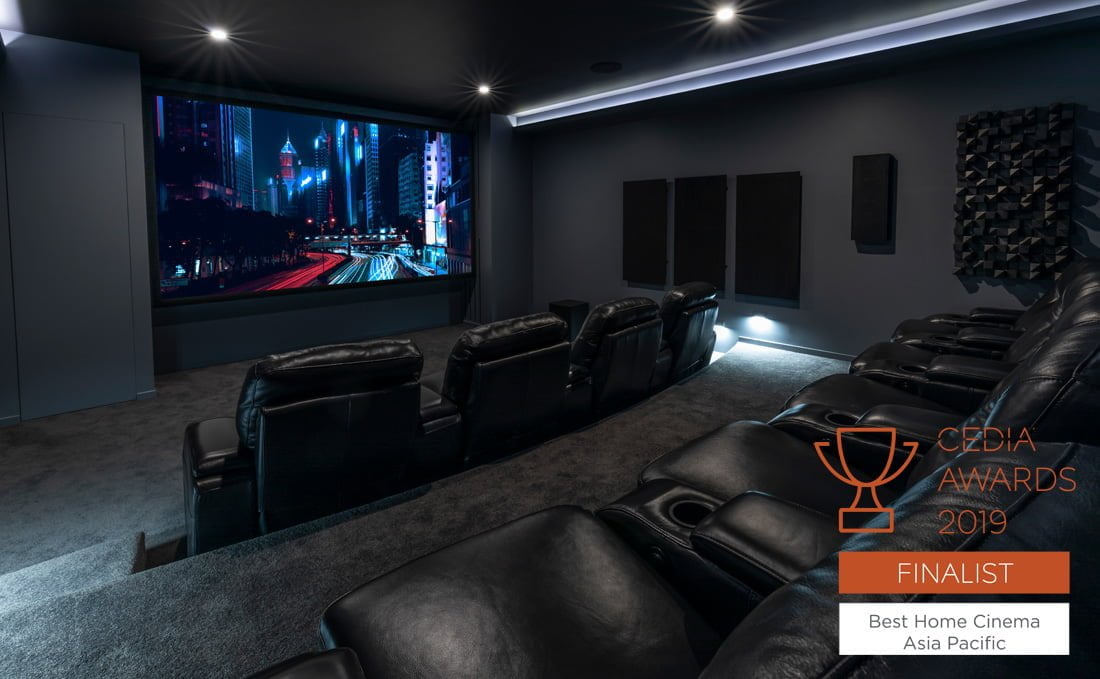
Digital Picture Wins Finalist at CEDIA Awards 2019 for Best […]

After meeting with you, we develop exclusive designs that will maximise the performance of your home theatre system and complement your individual style. Our full suite of engineering, architecture, interior design and installation services streamlines the process, ensuring we are able to maintain your vision from first concepts through to completion.