
Blog article
AV Receivers vs Audio Processors: What’s the Difference and When Does It Matter?
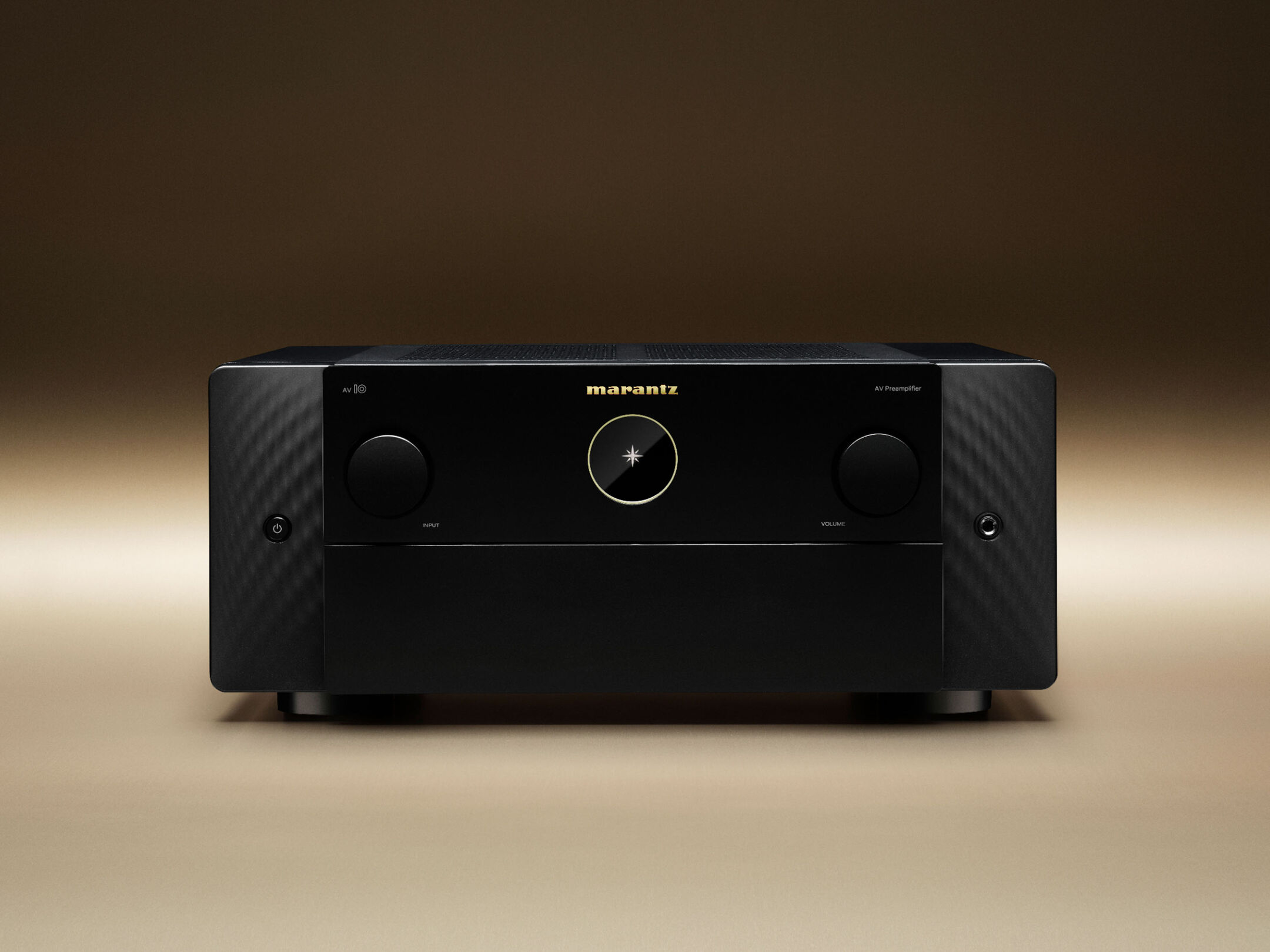
Most people shopping for a home cinema end up staring at the same question: do I need an AV receiver, or an audio processor? The terminology sounds technical. The price difference can be significant. And most product listings don’t explain what you actually get for the step up.
Here’s what the difference actually means for your cinema, and how to know which one belongs in your room.
What an AV Receiver Does
An AV receiver is an all-in-one unit. It handles HDMI switching, surround sound processing, volume control, room calibration, and speaker amplification – all inside a single box. If it’s a 9-channel receiver, it has 9 amplifier channels built in. You connect your speakers directly to it, and it drives them.
The appeal is obvious: one unit, one power connection, and a simpler signal chain.
The constraint is power. A typical Denon or Marantz AV receiver runs off a single internal power supply shared across all amplifier channels. Manufacturers often quote figures like 200 watts per channel, but that rating only applies when one or two channels are running simultaneously. Drive all channels at once – which is exactly what happens during a film with active surround, overhead, and bass content – and that figure can drop to somewhere between 70 and 90 watts per channel.
For a smaller room with efficient speakers, that’s generally fine. Speakers with high sensitivity can run comfortably off 100 watts without strain. But in a larger room, with heavier loads and more demanding content, you start to hear the limits. The system loses authority. Heavy action scenes – explosions, gunshots, fast-moving surround effects – sound compressed rather than immediate.
What an Audio Processor Does Differently
An audio processor handles everything an AV receiver does except amplification. It processes the surround sound, manages room calibration, controls volume, and outputs a fully processed audio signal – but that signal goes to a separate, external power amplifier before it reaches your speakers.
That separation is where the advantage lives.
A dedicated multi-channel power amplifier – say a 12-channel or 16-channel unit – delivers between 200watts to 800watts per channel with every channel running simultaneously. Your speakers get consistent, dedicated power regardless of what’s happening on screen. The result is a system that stays controlled and authoritative under heavy loads: faster transient response, lower distortion, and a noticeably cleaner sound when the film demands it.
There’s a second benefit beyond raw power. Dedicated processors – particularly the Marantz AV10 and AV20 – are built to a higher component standard than integrated receivers. The audio circuitry is more refined. The signal leaving the processor is cleaner before it even reaches the amplifier. So the step up to a processor gives you both more power and a higher quality audio signal.
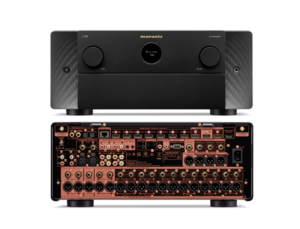
Marantz AV10
The Hybrid Option: Using Pre-Outs on Your Receiver
Most quality AV receivers include RCA pre-outs alongside their built-in amplification. That’s worth understanding, because it offers a practical middle path.
If your front speakers are larger, or your room runs longer than typical, you can add a 3-channel external power amplifier for the left, centre, and right channels while running your surround and overhead speakers from the receiver’s built-in amplification. The front speakers get dedicated power. And because the receiver is now driving fewer channels from its internal supply, the remaining speakers get more headroom too. You’re not replacing the receiver – you’re extending it.
It’s a sensible upgrade path for rooms that sit between tiers. Not every room needs a full processor and separate power amplification from day one.
When Trinnov Changes the Equation
When we step up to Trinnov, the conversation shifts. Trinnov only makes dedicated processors – there’s no integrated receiver option. The new AltitudeCI, Altitude 16 and Altitude 32 are purpose-built for one thing: extracting the best possible audio performance from your room and your speakers.
Trinnov’s processor is paired with external power amplification, including Trinnov’s own Amplitude16 power amplifier. The combination delivers high power and exceptional build quality throughout the signal chain. But the real differentiator is Trinnov Optimizer.
Optimizer analyses your room acoustically and calibrates every speaker and subwoofer as an integrated system. You have precise control over the target curve – the tonal character of your speakers – so the sound can be tuned to perform exactly the way it should in your specific room, rather than a generic average.
And then there’s Trinnov WaveForming. WaveForming uses multiple subwoofers in a transmit-and-receive array: front subwoofers project the bass energy into the room, rear subwoofers catch and cancel the reverb and room modes created by the front units. What you hear is tighter, cleaner bass with consistent coverage across every seat. It’s a fundamentally different approach to bass management, and it’s only available through Trinnov. We’ve covered WaveForming in its own article if you want the full technical detail.
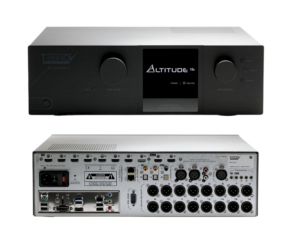
Trinnov Altitude 16
Calibration Software: The Part Most People Don’t Know About
No processor – at any level – performs at its best without proper calibration software. This is worth understanding because the software is as important as the hardware.
With Denon and Marantz systems, we use Dirac. In its standard form, Dirac Live with Bass Control does excellent work in a typical 5.1.2 or 5.1.4 room with a single subwoofer. The result is a well-integrated, natural-sounding system.
The significant step up is Dirac ART – Active Room Treatment. ART uses every speaker in the room, not just the subwoofers, to create consistent bass response from 150Hz and below across all seats. In a traditional system, bass reproduction is handled entirely by the subwoofers. With Dirac ART, all speakers contribute to an even bass field throughout the room, cancelling the seat-to-seat inconsistencies that bass frequencies typically cause.
Newer Denon and Marantz processors running Dirac ART now include four independent subwoofer outputs, because ART can manage four subwoofers individually and calibrate them as one unified channel. The results are world-class for what the hardware costs.
Trinnov Optimizer works differently but achieves related goals through its own approach to multi-subwoofer calibration and speaker integration, with more granular control available at the top end of the signal chain.
Which One Belongs in Your Room?
The honest answer depends on your room size, your speaker load, and how far you want to take the audio performance.
A well-specified AV receiver handles a smaller room properly. Pair it with Dirac ART and four subwoofers and the result is genuinely excellent. As your room grows, or as you push toward reference-level performance, a dedicated audio processor with external amplification gives you the power headroom and signal quality your speakers need to perform at their best. Trinnov sits at the top of that chain – the choice when nothing in the system should be a limiting factor.
If you’re not sure where your room sits in that range, the best starting point is a conversation about your space. Talk to us about your cinema and we’ll tell you exactly what it needs.
More articles

Scott Sauer
9 October, 2020

Scott Sauer
2 April, 2019
What is an acoustically transparent screen and why do I […]

Scott Sauer
21 April, 2021
Sony’s new flagship projector the VPL-GTZ380 has recently hit the residential market and it outshines its competitors.

Scott Sauer
22 January, 2020
THE DIGITAL PICTURE WINS CEDIA AWARD FOR BEST HOME CINEMA […]




After meeting with you, we develop exclusive designs that will maximise the performance of your home theatre system and complement your individual style. Our full suite of engineering, architecture, interior design and installation services streamlines the process, ensuring we are able to maintain your vision from first concepts through to completion.